Finding the right lighting for your retail store doesn’t have to be a guessing game. It’s really about balancing the right amount of light – measured in lumens – with energy efficiency, all while considering the size and purpose of different areas within your space. We’ll dive into the practicalities of choosing light fixtures and wattages so you can create an inviting and effective shopping environment without overspending or under-lighting.
Understanding the Basics: Lumens, Watts, and Light Output
Before we get into specific recommendations, let’s clear up some common terms that often get confused. When we talk about lighting, particularly for a retail environment, understanding the difference between lumens and watts is crucial. It’s a common misconception that watts indicate brightness, but that’s not quite right.
The True Measure of Brightness: Lumens
Lumens (lm) are the actual measurement of the total amount of visible light produced by a lamp or light source. Think of it as the volume of light. The higher the lumen output, the brighter the light appears to be. When you’re choosing bulbs or fixtures for your store, lumens are what you should be focusing on to ensure adequate illumination. A space might need a certain number of lumens per square foot to be properly lit, regardless of the wattage of the bulbs used.
Watts: A Measure of Energy Consumption
Watts (W) measure the amount of electrical power consumed by a light source. While older incandescent bulbs had a direct correlation between wattage and brightness (a 100W incandescent was brighter than a 60W one), this isn’t true for modern LED or fluorescent lighting. An LED bulb can produce the same amount of lumens as an incandescent bulb while consuming significantly fewer watts. So, when you see a 60W equivalent LED bulb, it means it produces a similar lumen output to a traditional 60W incandescent, but it uses far less energy. Focusing on watts primarily tells you about your energy bill, not the brightness of your store.
Efficacy: Lumens Per Watt
A useful metric to understand is efficacy, often expressed as lumens per watt (lm/W). This tells you how efficiently a light source converts electrical energy into visible light. A higher lm/W means the light is more efficient, producing more light for less energy. This is a key factor in choosing cost-effective and environmentally friendly lighting for your retail space. For example, if you have two bulbs that both produce 800 lumens, but one uses 10 watts and the other uses 15 watts, the 10-watt bulb has higher efficacy and is the better choice for energy savings.
Determining Recommended Light Levels (Foot-Candles/Lux)
Now that we understand lumens, how do we translate that into practical application for a retail store? This is where light level recommendations come in, typically expressed in foot-candles (fc) in the US, or lux (lx) in most other parts of the world. One foot-candle is approximately 10.76 lux, so they’re essentially different units for measuring the same thing: the density of light falling on a surface.
General Retail Lighting Standards
There isn’t a single, one-size-fits-all answer for retail lighting, as different areas within a store have different needs. However, there are established guidelines. The Illuminating Engineering Society (IES) provides detailed recommendations. For general retail sales areas, a common range is between 30 and 70 foot-candles (approximately 300-750 lux). This provides enough light for customers to comfortably navigate, see products, and read labels without feeling overwhelmed or like they’re in a dimly lit space.
Specific Area Considerations
It’s important to tailor your lighting to specific zones within your store.
Display Areas and Feature Walls
These areas often require higher light levels to draw attention to merchandise. Think 70 to 100 foot-candles (750-1000 lux) or even higher, especially if you’re highlighting high-value items or new arrivals. Accent lighting, with a tighter beam angle and higher intensity, is typically used here. This makes products pop and stand out from the general ambient lighting.
Checkout Counters and Dressing Rooms
These are functional areas where customers need clear visibility. For checkout counters, 50 to 70 foot-candles (500-750 lux) is usually appropriate to ensure employees can easily scan items and handle transactions, and customers can see their purchases and payment options clearly. Dressing rooms also benefit from good, even lighting, typically around 50 foot-candles, to help customers accurately assess how clothing looks on them. Avoid harsh, overhead-only lighting in dressing rooms, as it can create unflattering shadows.
Back Rooms and Storage
These areas don’t need the same aesthetic appeal but require sufficient light for safety and efficiency. Around 20 to 30 foot-candles (200-300 lux) is usually adequate for general storage, ensuring employees can safely move around and locate items.
Calculating Required Lumens
Once you have your target foot-candle (or lux) value for an area, you can estimate the total lumens needed.
- For Foot-Candles: Multiply the desired foot-candle level by the square footage of the area.
- Example: A 500 sq ft sales floor needing 50 fc would require 500 sq ft * 50 fc = 25,000 lumens.
- For Lux: Multiply the desired lux level by the square meters of the area.
- Example: A 50 sq meter sales floor needing 500 lux would require 50 sq m * 500 lux = 25,000 lumens.
This total lumen calculation gives you a target. You’ll then distribute this across multiple fixtures. Keep in mind that this is a simplified calculation and doesn’t account for light loss factors (like dirt accumulation on fixtures or lamp depreciation over time), ceiling height, or the reflectivity of surfaces. A professional lighting designer would use more complex software to account for these variables, but this provides a good starting point for practical planning.
Fixture Types and Their Role in Retail
The type of light fixture you choose plays a significant role in not just the aesthetic of your store but also how effectively light is distributed and used. Different fixtures are designed for different purposes and can dramatically impact the overall shopping experience.
Ambient Lighting: The Foundation
Ambient lighting provides the general illumination for your store, ensuring customers can move around safely and comfortably. It’s the primary layer of light.
Recessed Troffers and Panels
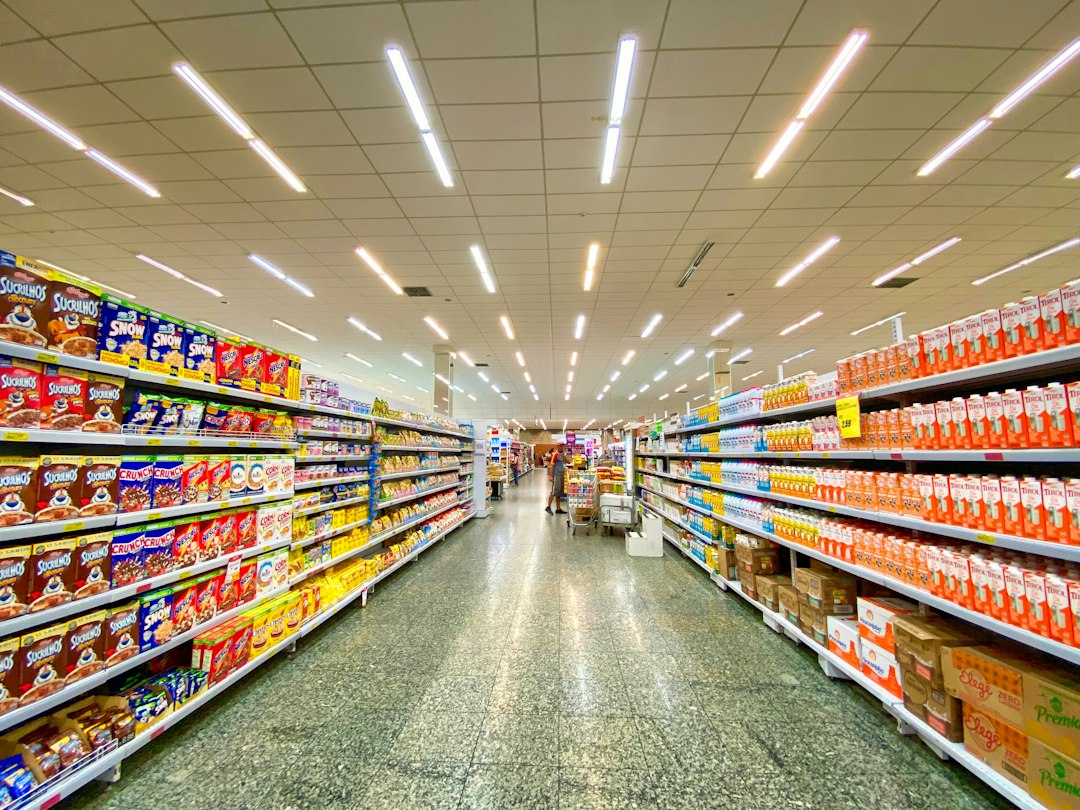
Common in many retail environments, especially those with drop ceilings. LED flat panels are becoming increasingly popular due to their sleek appearance, even light distribution, and energy efficiency. They provide a broad, diffuse light that reduces harsh shadows. Ideal for general sales floors, aisles, and backroom areas where uniform illumination is key. Sizes range from 1×4 ft, 2×2 ft, to 2×4 ft, with lumen outputs varying widely from 2,000 to over 7,000 lumens per fixture, depending on the wattage and efficacy.
Linear Suspended Lights
Often used in stores with higher ceilings or an industrial aesthetic. These fixtures provide continuous, even light along aisles or over large open areas. They can be very energy efficient, especially LED versions. They come in various lengths and can be linked together to create long runs of light.
Accent Lighting: Highlighting Merchandise
Accent lighting is crucial for retail. Its purpose is to draw attention to specific products, displays, or architectural features. It typically has a narrower beam angle and higher intensity than ambient lighting.
Track Lighting
Extremely versatile, track lighting allows you to position and aim individual light heads precisely where needed. This is perfect for highlighting merchandise on shelves, mannequins, or display tables. LED track heads offer excellent color rendering and can be easily adjusted as store layouts change. Wattages for individual track heads can range from 10W to 40W, providing lumen outputs from 800 to 3,000 lumens, with varying beam angles from narrow spot to wide flood.
Recessed Adjustable Downlights
Similar to track lighting in function, but more integrated into the ceiling, offering a cleaner look. These can be aimed to highlight specific areas or products. Often used in higher-end boutiques or showrooms where a less obtrusive lighting solution is desired.
Task Lighting: Functional Illumination
Task lighting is focused illumination for specific activities, like at a checkout counter or in a dressing room mirror. While some ambient and accent lighting may contribute, dedicated task lighting ensures sufficient brightness for these critical areas.
Under-Shelf Lighting and Integrated Fixtures
Small LED strips or puck lights integrated into shelving units can directly illuminate products, making them stand out and appear more appealing. This is especially effective for jewelry, cosmetics, or other small items.
Pendant Lights
While often decorative, pendant lights can also serve as effective task lighting over checkout counters or information desks, providing focused light where needed. Their height and design can also contribute to the store’s overall ambiance.
Sizing and Wattage Considerations: A Practical Approach
Once you have a handle on lumens, light levels, and fixture types, it’s time to put it all together to figure out the right size and wattage for your store. This involves a bit of estimation and understanding how different factors play a role.
Ceiling Height’s Impact
The height of your ceiling significantly impacts your lighting choices.
- Lower Ceilings (8-10 ft): In these spaces, light spreads out more effectively, so you might need fewer fixtures or fixtures with lower lumen outputs. Diffused ambient lighting like LED panels or wide-beam downlights work well to avoid glare and hotspots.
- Medium Ceilings (10-14 ft): This is a common retail height. You’ll likely need more robust fixtures or more of them to achieve the desired light levels. Consider a mix of ambient and accent lighting.
- High Ceilings (14+ ft): High ceilings require powerful fixtures with higher lumen output and often narrower beam angles to ensure light reaches the merchandise and floor effectively. High bay or suspended linear fixtures are common for general illumination, complemented by powerful track or recessed accent lights.
Number of Fixtures and Spacing
Instead of trying to find one super-bright bulb, it’s almost always better to distribute your required lumens across multiple fixtures. This provides more even illumination, reduces shadows, and offers greater flexibility.
General Spacing Guidelines
- Ambient Lighting: For general ambient lighting in a typical retail space, fixtures are often spaced between 8 to 12 feet apart in a grid pattern. This can vary based on the fixture’s lumen output and beam spread. The goal is to avoid dark spots between fixtures.
- Accent Lighting: Accent lights are positioned based on the specific items they need to highlight, often closer together over display areas. Aim for a 30-degree beam angle to give a good punch without being too narrow, and position them to create visual interest rather than just raw brightness.
Example Calculation Revisited
Let’s use our 500 sq ft sales floor needing 25,000 lumens. If you choose an LED panel that produces 4,000 lumens, you would theoretically need 25,000 / 4,000 = 6.25 fixtures. You’d likely round up to 7 or 8 fixtures to ensure even distribution and compensate for any light loss.
If these fixtures consume 40 watts each, then 8 fixtures would use 320 watts in total for your ambient lighting.
Wattage and Energy Efficiency
For modern retail lighting, especially with the prevalence of LEDs, focusing on wattage is primarily about energy consumption.
LED Replacements
When upgrading from older incandescent or fluorescent systems, you can achieve significant energy savings with LEDs. For example:
- Replacing a 60W incandescent: Look for an LED bulb that produces around 800 lumens, which typically consumes 8-12W.
- Replacing a 100W incandescent: Look for an LED bulb producing around 1600 lumens, typically consuming 15-20W.
- Replacing a T8 fluorescent tube (32W): An LED T8 equivalent might consume only 15-18W for a similar lumen output.
- Replacing Metal Halide High Bays (250W-400W): LED high bay fixtures can achieve similar light output at 100W-200W, sometimes even less.
The key is to match the lumen output of your existing system with the lumen output of the LED replacement, then note the significant wattage reduction.
Color Temperature (CCT) and Color Rendering Index (CRI)
While not directly about size or wattage, CCT and CRI are critical factors for retail lighting and impact how your store looks.
Color Temperature (CCT)
Measured in Kelvin (K), CCT describes the perceived warmth or coolness of the light.
- Warm White (2700K-3000K): Creates a cozy, inviting atmosphere. Good for boutiques, cafes, or stores selling home goods.
- Neutral White (3500K-4000K): A balanced light that’s good for general retail, providing clarity without being too harsh. Often a safe choice for most stores.
- Cool White/Daylight (5000K-6500K): Bright and crisp, often used in showrooms, electronics stores, or spaces where accuracy and alertness are desired. Can sometimes feel sterile if not balanced with other elements.
The most common range for general retail is 3500K-4000K, with some accent lighting possibly warmer or cooler depending on the product and desired effect.
Color Rendering Index (CRI)
CRI measures how accurately a light source reveals the true colors of objects compared to natural daylight. A higher CRI (on a scale of 0-100) means colors will look more vibrant and true-to-life.
- Retail Recommendation: Aim for a CRI of 80 or higher for general retail. For clothing stores, art galleries, or anywhere color accuracy is paramount, a CRI of 90+ is highly recommended. Low CRI lighting can make merchandise look dull, washed out, or even change its perceived color, leading to customer dissatisfaction.
Choosing lights with appropriate CCT and high CRI ensures your products are presented in the best possible light, enhancing their appeal and helping customers make confident purchasing decisions.
Optimizing and Controlling Your Lighting System
Once you’ve selected your fixtures and determined their placement, the job isn’t quite finished. Optimizing and controlling your lighting system can further enhance the shopping experience, save energy, and extend the life of your lights.
Dimming Capabilities
The ability to dim your lights offers immense flexibility and benefits.
Ambiance Control
Dimming allows you to adjust the mood and intensity of your store’s lighting throughout the day or for special events. For instance, you might want brighter lights during peak hours and a slightly softer glow during quieter times or evening hours. This adaptability helps create a more dynamic and inviting environment.
Energy Savings
Dimming directly translates to energy savings. Running lights at 70% intensity often uses significantly less power than running them at 100%, extending the lifespan of your LED fixtures. Even small adjustments can add up over time.
Extending Fixture Lifespan
LEDs generally have long lifespans, but running them at lower intensities through dimming can further extend their operational life, reducing maintenance and replacement costs.
Lighting Controls and Automation
Beyond simple dimmers, modern lighting controls offer sophisticated ways to manage your store’s illumination.
Occupancy Sensors
These sensors detect when people are present and automatically turn lights on or off, or dim them, in specific areas. They are particularly useful in back rooms, storage areas, restrooms, or even less-frequented aisles where constant full illumination isn’t necessary. This prevents lights from being left on accidentally in unoccupied spaces, saving energy.
Daylight Harvesting
If your store has significant natural light from windows or skylights, daylight harvesting systems can be a game-changer. These systems use sensors to detect the amount of natural light entering the space and automatically adjust the artificial lighting to maintain a consistent overall light level. This means that on a bright, sunny day, your artificial lights will dim down, saving considerable energy.
Timers and Scheduling
Programmable timers allow you to set specific on/off times for different zones of your store. You can program lights to turn on before opening, dim or brighten at certain times of the day, and turn off completely after closing. This ensures consistency and energy efficiency, eliminating reliance on manual switching.
Smart Lighting Systems
For larger or more complex retail spaces, smart lighting systems (often integrated with building management systems) provide centralized control over all aspects of your lighting. This allows for detailed scheduling, zone control, scene setting (pre-programmed lighting configurations for different moods or promotions), and even remote management. While an upfront investment, these systems offer unparalleled control and long-term operational savings.
Regular Maintenance and Cleaning
Even the best lighting system can lose its effectiveness without proper care.
Cleaning Fixtures and Lamps
Dust and dirt accumulation on light fixtures, diffusers, and bulbs can significantly reduce light output. Regular cleaning (as per manufacturer recommendations) helps maintain optimal brightness and efficiency.
Replacing Lamps (if applicable)
While LEDs have long lifespans, older fluorescent or HID systems still require lamp replacements. Staying on a schedule for these replacements ensures consistent light levels and avoids disruptive outages.
Inspecting Wiring and Controls
Periodically inspect wiring, connections, and control systems to ensure everything is functioning safely and correctly. Address any flickering, dimming issues, or control malfunctions promptly.
By considering these optimization and control strategies, you can not only achieve perfect illumination for your retail store but also create a sustainable, energy-efficient, and adaptable lighting environment that enhances the customer experience and supports your business goals.