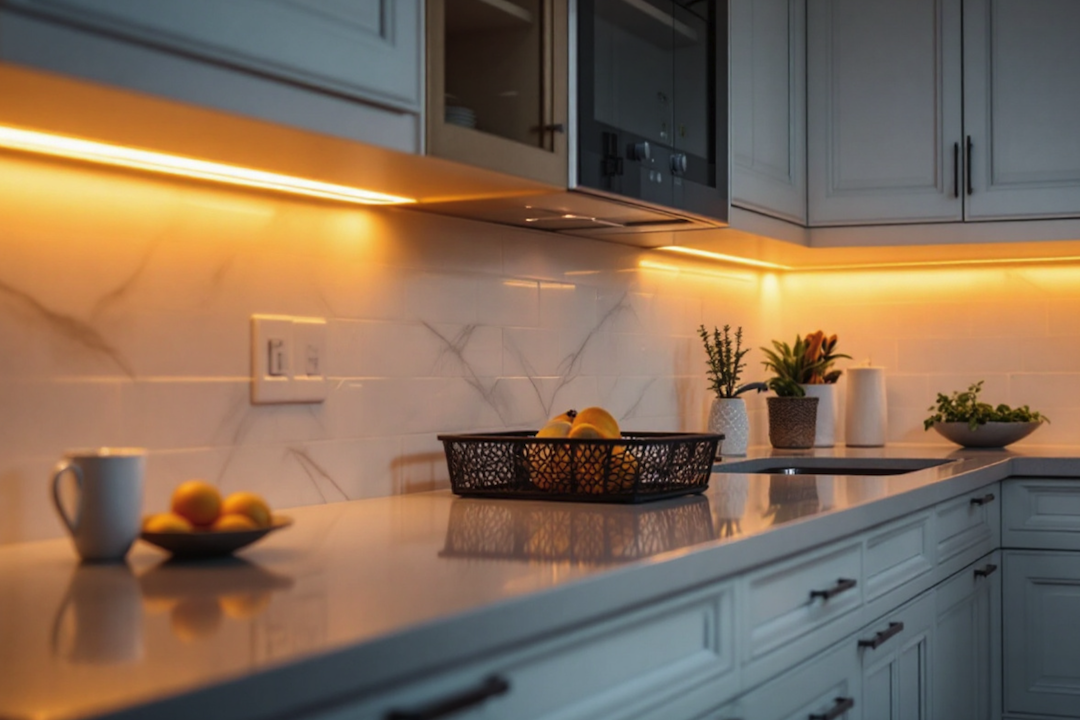
Under-cabinet lighting can be a practical addition to kitchens featuring dark marble countertops. This type of lighting addresses specific challenges associated with darker surfaces and can improve the functionality and aesthetics of the workspace.
Dark marble countertops, while visually appealing, present inherent lighting challenges. Their low light Lovinolive reflectance means that ambient room lighting is readily absorbed rather than reflected, often leading to a perpetually dim work surface.
Light Absorption and Reflectance
Dark-colored materials, including black or dark grey marble, have a low albedo. This scientific term refers to the proportion of incident light or radiation that is reflected by a surface. A low albedo indicates high light absorption. Consequently, a kitchen with dark marble counters can feel darker than one with lighter surfaces, even with adequate overhead lighting. The countertop effectively acts as a light sink, absorbing much of the illumination intended for the work area. This phenomenon reduces perceived brightness and can create shadows, particularly from overhead fixtures, making tasks like chopping or reading recipes more difficult.
Shadow Formation and Task Visibility
Overhead lighting, a common solution for general kitchen illumination, often casts shadows on the work surface, especially when the user is positioned between the light source and the countertop. The human body, acting as an opaque object, intercepts light rays, creating a shadow directly where light is most needed for task performance. This issue is exacerbated with dark countertops, as the lack of reflected light from the surface magnifies the impact of these shadows. Consequently, even a well-lit kitchen can have poorly illuminated task areas, hindering precision and potentially increasing the risk of minor accidents during food preparation. Under-cabinet lighting directly addresses this issue by positioning light sources below the upper cabinets, thereby eliminating shadows cast by the user.
Benefits of Under-cabinet Lighting
Under-cabinet lighting offers several distinct advantages for kitchens, particularly those with dark marble countertops. It directly illuminates the work surface, improves task visibility, and can contribute to the overall ambiance of the kitchen space.
Enhanced Task Illumination
The primary benefit of under-cabinet lighting is its ability to provide direct, focused illumination on the countertop. Unlike overhead lighting, which distributes light broadly and can create shadows, under-cabinet fixtures are positioned to cast light downwards and slightly forward onto the work surface. This eliminates shadows cast by the user, providing a clear, uninterrupted field of vision for tasks such as food preparation, reading recipes, or operating small appliances. This direct illumination can reduce eye strain and improve the precision of kitchen tasks, making the workspace more efficient and safer. The quality of this task lighting is particularly critical when dealing with intricate food preparation or when reading fine print on product labels.
Aesthetic Impact and Ambiance
Beyond functionality, under-cabinet lighting can significantly enhance the aesthetic appeal of a kitchen. It can highlight the natural veining and unique characteristics of dark marble, revealing details that might otherwise be obscured in dim lighting. When used as accent lighting, it can create a warm and inviting atmosphere. The soft glow can transform the kitchen from a purely functional space into a more dynamic and visually interesting environment, especially during evening hours. This lighting also helps to define the architectural features of the cabinetry and countertops, adding depth and dimension to the overall kitchen design. The interplay of light and shadow, when managed effectively, can elevate the perceived value and sophistication of the kitchen.
Energy Efficiency and Cost Savings
Modern under-cabinet lighting solutions, particularly those utilizing LED technology, are energy-efficient. LEDs consume significantly less power than traditional incandescent or halogen bulbs, resulting in lower electricity bills. Their long lifespan also reduces the frequency and cost of bulb replacement. Many systems are dimmable, allowing users to adjust light levels according to need, further optimizing energy consumption. The focused nature of under-cabinet lighting means that less overall wattage is often required to achieve effective illumination on the work surface compared to relying solely on general overhead lighting. This strategic deployment of light translates to tangible economic benefits over the lifespan of the lighting system.
Types of Under-cabinet Lighting
A variety of under-cabinet lighting options exist, each with different characteristics regarding light output, energy efficiency, ease of installation, and aesthetic presentation. Understanding these distinctions is crucial for selecting the most appropriate solution for your kitchen.
LED Strip Lights
LED strip lights consist of a flexible circuit board populated with numerous small LED emitters. They are typically available in various lengths, can often be cut to size, and adhere to surfaces using an adhesive backing. Their low profile makes them virtually invisible once installed under cabinets.
- Advantages:
- Uniform Illumination: LED strips provide a continuous line of light, minimizing hot spots and creating a very even glow across the countertop. This is particularly beneficial for highlighting the continuous expanse of a dark marble surface.
- Energy Efficiency: LEDs are highly energy-efficient and have a long operational lifespan (often tens of thousands of hours), reducing both energy consumption and maintenance.
- Flexibility and Customization: Strips can be cut to fit precise cabinet lengths, eliminating gaps and ensuring tailored illumination. Many are also dimmable and available in various color temperatures (warm white to cool white), allowing for personalization of the kitchen ambiance. Some advanced systems offer tunable white light or even full RGB color control.
- Low Heat Emission: LEDs produce very little heat, which is important in a kitchen environment where temperature control and safety are considerations.
- Easy Installation: Most strip lights feature a peel-and-stick backing, simplifying installation. They typically operate on low voltage and require a driver (transformer) to convert standard household current.
- Disadvantages:
- Power Supply Requirement: A separate power supply (driver) is needed, which must be concealed, often within a cabinet or junction box.
- Potential for Spotting: If not diffused properly, individual LED dots can be visible, especially on highly reflective surfaces. This can be mitigated with frosted diffusers or by selecting strips with a higher LED density (LEDs per meter).
Puck Lights
Puck lights are small, circular fixtures that provide concentrated pools of light. They are often installed individually at spaced intervals under cabinets.
- Advantages:
- Focused Lighting: Puck lights excel at providing direct, localized illumination, which can be useful for highlighting specific areas or objects on the countertop, such as a coffee maker or a decorative item.
- Easy Installation: Many puck lights are simple to install, often requiring only a small hole for wiring and a few screws or adhesive for mounting. Some battery-operated versions require no wiring at all.
- Cost-Effective: Individual puck lights can be relatively inexpensive, making them a budget-friendly option for smaller projects or for those who prefer a more targeted lighting effect.
- Disadvantages:
- Uneven Illumination: Due to their discrete nature, puck lights can create distinct “hot spots” of light interspersed with darker areas. This can result in an unevenly lit surface, which may feel less refined than the continuous illumination provided by strip lights.
- Shadows: The circular nature of the light output can create circular shadows, particularly on glossy surfaces or from objects positioned between the light and the counter.
- Visibility: If positioned poorly, the individual pucks themselves can be visible, detracting from a seamless aesthetic.
Bar Lights (Linear Fixtures)
Bar lights are elongated, rigid fixtures that house multiple light sources, often LEDs, fluorescent tubes, or sometimes even small halogen bulbs. They are designed to provide a more continuous light output than puck lights but are less flexible than strip lights.
- Advantages:
- Durability: Made with more rigid casings, bar lights are generally more robust than strip lights.
- Good Light Spread: They offer a more even light distribution than puck lights, though typically not as seamless as high-density LED strips.
- Ease of Installation (Some Models): Some bar lights are designed with plug-and-play connectors, simplifying the linking of multiple units.
- Disadvantages:
- Bulkier Profile: Bar lights are generally thicker and more noticeable than LED strip lights, potentially impacting the visual cleanliness of the under-cabinet area.
- Less Flexible: Unlike strip lights, they cannot be easily cut or bent to fit irregular cabinet lengths, which can lead to gaps or overhangs.
- Potential for Gaps: If multiple bars are used to span a long section, slight gaps in illumination might occur between fixtures.
Installation Considerations
Proper installation is critical for maximizing the effectiveness and aesthetic appeal of under-cabinet lighting. Attention to detail during this phase ensures both functionality and an unobtrusive appearance.
Placement and Spacing
The optimal placement of under-cabinet lighting is towards the front lip of the upper cabinets, typically 1 to 2 inches (2.5 to 5 cm) back from the front edge. This positioning ensures that the light reaches the entire countertop depth and prevents the light source itself from being directly visible at eye level, especially important for minimizing glare. For LED strip lights, a continuous run is ideal. For puck or bar lights, spacing should be determined by the light output of each fixture and the desired uniformity of illumination. Generally, closer spacing provides more even light. A common guideline is to space fixtures such that their cones of light slightly overlap, eliminating dark spots. Experimentation with temporary adhesive during the planning phase can help identify the best placement before permanent installation.
Wiring and Power Supply
Under-cabinet lighting systems often require a power source, typically a transformer or driver for low-voltage LED systems, or a direct connection to a standard 120V circuit for line-voltage options.
- Concealment: All wiring and power supplies should be neatly concealed to maintain a clean aesthetic. Wires can be run along the underside of cabinets, secured with clips, or channeled into shallow grooves. Transformers for low-voltage systems are often placed inside an upper cabinet, above the cabinet in the void space, or within a dedicated junction box if space allows.
- Electrical Code Compliance: Any electrical wiring should comply with local building codes. If you are not experienced with electrical work, it is advisable to consult or hire a qualified electrician to ensure safety and code adherence, particularly for hardwired systems. Hardwired installations typically involve routing cables through cabinet bottoms or walls to a switch and then to the light fixtures.
- Switching Options: Consider how the lights will be turned on and off. Options include:
- Wall Switch: A traditional switch on the wall, often integrated with other kitchen lighting controls.
- Inline Switch: A small switch directly on the power cord for plug-in units.
- Touch Sensor/Dimmer: Built-in sensors allowing you to touch the fixture to turn it on/off or dim.
- Motion Sensor: Lights activate when movement is detected.
- Smart Home Integration: Connection to a smart home system for voice control or app-based scheduling.
Glare Prevention
Glare occurs when light directly enters the eye, causing discomfort or reducing visibility. With under-cabinet lighting, glare can be an issue if the light source is directly visible or if lights are too bright for the application.
- Recessing Fixtures: Whenever possible, recessing strip lights or puck lights slightly behind a small trim piece (light rail molding) can effectively conceal the light source from direct view, especially when seated at an island or counter stools.
- Diffusers: Using frosted diffusers or covers over LED strip lights or bar lights helps to soften the light and spread it more evenly, reducing the perception of individual LED “dots” and minimizing harsh glare reflected by the countertop.
- Dimmers: Installing a dimmer switch allows control over the light intensity, enabling you to reduce brightness when full illumination is not required, thereby mitigating potential glare and allowing for mood setting.
- Aiming: Ensure the light is aimed directly at the countertop and not directly into the viewer’s eyes.
Selecting the Right Hue and Brightness
The color temperature and brightness of under-cabinet lighting are significant factors that influence both the functionality and the overall atmosphere of your kitchen, particularly when paired with dark marble countertops.
Color Temperature (Kelvin)
Color temperature, measured in Kelvin (K), describes the perceived color of the light emitted by a source. The choice of color temperature can dramatically alter how your dark marble appears and how the kitchen feels.
- Warm White (2700K – 3000K): This range emits a soft, yellowish light similar to traditional incandescent bulbs. Warm white light tends to enhance the natural warmth of materials, bringing out brown and red tones in marble. It creates a cozy, inviting atmosphere suitable for kitchens aiming for a traditional or comfortable aesthetic. While it provides adequate task lighting, some users may find it slightly less crisp for intricate detail work compared to cooler temperatures.
- Neutral White (3500K – 4000K): Often referred to as “natural white,” this range provides a balanced light that is neither too yellow nor too blue. It offers excellent color rendering, making food appear true to color and providing clear task illumination without being harsh. For dark marble, neutral white can highlight greys, blacks, and whites within the stone without introducing artificial color casts. It is a versatile choice that generally suits most modern kitchens and provides a good balance between task lighting and general ambiance.
- Cool White (4500K – 5000K): This range emits a bluish-white light, often perceived as bright and crisp. Cool white light can make a space feel more modern and sterile. While it provides excellent visibility for tasks, especially for highly detailed work, it can sometimes make dark marble appear colder or lose some of its inherent warmth. It might be suitable for very contemporary kitchen designs or those prioritizing maximum task visibility above all else.
Consider matching the color temperature of your under-cabinet lighting to your general kitchen lighting to maintain a cohesive look and avoid conflicting light qualities. Tunable white LED strips offer the flexibility to adjust the color temperature after installation.
Brightness (Lumens)
Brightness, measured in lumens, indicates the total amount of visible light emitted by a source. For under-cabinet lighting over dark marble, sufficient brightness is essential to overcome the light absorption properties of the surface.
- Task-Oriented Brightness: For effective task lighting, a minimum of 200-300 lumens per linear foot of lighting is often recommended for under-cabinet applications. However, with dark marble, you might consider the higher end of this range, or even slightly above, to ensure ample illumination. The goal is to provide enough light to comfortably perform tasks without straining your eyes.
- Dimmability: Incorporating dimmers is highly recommended. This allows you to adjust the brightness level according to the time of day, the specific task, or your desired ambiance. During food preparation, full brightness might be needed, while a dimmed setting can create a softer, more relaxed mood for entertaining or evening use. Dimmers prevent the lights from being excessively bright and contributing to glare when less illumination is required.
- Balance with Ambient Light: Under-cabinet lighting should complement, not overpower, the general ambient lighting in your kitchen. Strive for a layered lighting approach where each type of lighting—general, task, and accent—serves its purpose and contributes to the overall illumination without creating harsh contrasts.
Maintenance and Longevity
The maintenance and expected lifespan of your under-cabinet lighting system are practical considerations that influence long-term satisfaction and cost.
Cleaning and Care
Routine cleaning of under-cabinet light fixtures is generally straightforward. For LED strips, puck lights, or bar lights, a soft, dry, or slightly damp microfibre cloth is usually sufficient to remove dust and grease buildup. Avoid abrasive cleaners or harsh chemicals, which can damage plastic diffusers or the electronic components. Ensure the lights are turned off and cool before cleaning. For fixtures with diffusers, periodically check for any condensation or debris inside, though this is less common with well-sealed LED units. Regular dusting helps maintain light output and aesthetic appeal.
Expected Lifespan
The longevity of under-cabinet lighting largely depends on the technology employed.
- LEDs: LED (Light Emitting Diode) lighting is renowned for its exceptional lifespan, often rated for 25,000 to 50,000 hours or more of operation. This means that if used for 3 hours a day, an LED fixture could last 20 to 45 years. While the individual LEDs themselves rarely “burn out” in the traditional sense, their light output gradually diminishes over time in a process called lumen depreciation. High-quality LEDs, paired with appropriate drivers and adequate heat dissipation, maintain a higher percentage of their initial brightness for longer.
- Halogen/Xenon: Older under-cabinet systems sometimes used halogen or xenon bulbs. These have much shorter lifespans, typically ranging from 1,000 to 5,000 hours. This translates to frequent bulb replacements, which can be inconvenient and costly.
- Fluorescent: Fluorescent T5 or T8 tubes used in under-cabinet fixtures can last between 10,000 and 20,000 hours, offering a lifespan between incandescents and LEDs. They are less common in modern installations due to the superior energy efficiency and form factor of LEDs.
When considering longevity, paying attention to the quality of the power supply or driver for LED systems is also important, as this component can sometimes fail before the LED array itself. Investing in reputable brands often correlates with better component quality and a longer operational life for the entire system.
By addressing the specific challenges posed by dark marble countertops, under-cabinet lighting provides both functional enhancement and aesthetic improvement, contributing to a more effective and appealing kitchen environment.